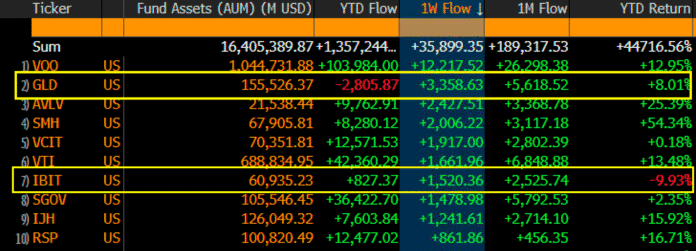
Gold and Bitcoin exchange-traded funds (ETFs) drew roughly $7 billion over five US trading sessions, a record combined haul that puts both assets at the center of a renewed investor push for protection against currency weakness and mounting fiscal pressure.
About $3.4 billion of this capital went into SPDR Gold Shares (GLD) while BlackRock’s iShares Bitcoin Trust (IBIT) attracted roughly $1.5 billion. GLD manages more than $150 billion in assets, while IBIT holds around $60 billion, making each the dominant institutional access point in its respective market.
Together, the two funds accounted for about 70% of the combined “debasement trade” inflow, showing how strongly the move was concentrated in the largest vehicles.
Bloomberg Intelligence analyst Eric Balchunas said the five-day total was easily a record for the pair, with both GLD and IBIT ranking among the 10 biggest US ETFs by weekly inflows. He also noted that IBIT’s year-to-date flows had returned to positive territory after recovering from an earlier deficit.
The surge came as both assets climbed sharply. Bitcoin broke above $80,000, while gold traded above $4,600 an ounce, extending a move that has increasingly linked the two through the same scarcity narrative.
Fiscal pressure revives demand for hard assets
The synchronized buying accelerated as investors focused on US debt, Treasury-market strains and a softer dollar.
Treasury’s Aug. 19 decision to at least double the maximum size of liquidity-support buybacks for longer-dated securities to $4 billion per operation added to that backdrop. The change helped pull long-term yields lower initially and came with U.S. public debt already above $40 trillion.
That combination has revived the so-called debasement trade, where investors seek assets with constrained supply as protection against the possibility that persistent deficits and currency expansion erode purchasing power.
Bitwise Chief Investment Officer Matt Hougan said the attraction partly reflects how traditional portfolios remain fully denominated in fiat money.
“A 60/40 portfolio is 100% exposed to fiat currency,” Hougan said, arguing that investors are increasingly looking for a modest source of diversification as fiscal uncertainty rises.
Strive Chief Executive Matt Cole framed the same shift through scarcity, saying dollar debasement expands the pool of capital searching for limited-supply assets and that Bitcoin’s continuing monetization allows it to capture a growing share of that demand.
Bitcoin’s fixed 21 million supply makes it an obvious candidate for that trade, although it remains far more volatile than gold and has a much shorter history as a defensive asset.
Market trends are currently moving in the same direction. Charlie Morris, founder of ByteTree, pointed out that both Bitcoin and gold have positively sloping 200-day moving averages and carry ByteTrend scores of 5, the firm’s strongest bullish reading. The dollar, by contrast, carries a score of zero.
That alignment does not establish why investors are buying, but it reinforces the divergence now visible between scarce assets and the currency against which they are priced.
Wall Street sees a longer-term scarcity trade
The stronger argument for the trade is that the pressure may persist even after the latest move in yields and the dollar fades.
Bernstein said the four-decade decline in interest rates appears to have ended just as sovereign debt burdens have reached record levels, leaving governments more exposed to rising debt-servicing costs. Higher yields can then feed back into larger interest bills, wider deficits and greater borrowing needs, increasing the difficulty of stabilizing public finances.
The firm expects policymakers facing that tradeoff to ultimately favor currency debasement over prolonged fiscal restraint, which it views as the less politically disruptive path.
That would strengthen the case for assets whose supply cannot be readily expanded.
Bernstein said Bitcoin is particularly well positioned because of its fixed issuance, wider institutional and retail access, and a holder base that has historically absorbed severe drawdowns. It estimates about 60% of Bitcoin is held by investors that remained through declines of more than 50%.
BlackRock has also pushed Bitcoin further into conventional portfolio discussions. In research published this month, the asset manager said historical modeling showed that a 1% to 2% Bitcoin allocation could have improved the risk-adjusted performance of a traditional 60/40 portfolio.
Those arguments help explain why the latest ETF flows are attracting more attention than another short-term rally.
Gold already has an established role as protection against monetary and fiscal uncertainty. Bitcoin is increasingly being considered for the same scarcity allocation, but its record remains far shorter and its volatility substantially higher.
That leaves Bitcoin with a test gold does not face to the same degree.
If the dollar strengthens or real yields rise and Bitcoin ETFs continue attracting capital, the latest $7 billion co-inflow would look more like a durable shift in portfolio construction than a trade built around favorable macro conditions.
However, if Bitcoin demand fades while gold remains resilient, the two assets may have benefited from the same debasement narrative without yet earning the same status in investor portfolios.