Crypto exchange CoinEx is shutting down after nine years, citing shrinking revenue and rising compliance costs as the reasons the exchange is no longer viable.
The centralized crypto platform said Sept. 15 that it will wind down operations in stages, ending spot trading on Sept. 29 before closing withdrawals on Dec. 22. New registrations have stopped, futures markets have moved to reduce-only mode, and other products, including margin trading, loans, Earn, and staking, are being phased out.
Founder Haipo Yang said CoinEx had failed to become one of the industry’s leading exchanges, leaving the company carrying security and compliance obligations that had become increasingly difficult to justify against the revenue it generated.
“Revenues can decline, responsibility does not,” Yang said in a statement. “Carrying unlimited risk for limited revenue is no longer a rational choice.”
CoinEx also cited a prolonged contraction in crypto trading volume and liquidity alongside rising regulatory requirements across major jurisdictions. The exchange had already surrendered access to one of those markets in 2023 after settling a case brought by New York Attorney General Letitia James.
The agreement required CoinEx to withdraw its platform and services from the US after New York accused it of operating without registering as a securities and commodities broker-dealer. The company agreed to refund more than $1.1 million to 4,691 New York investors and pay over $600,000 in penalties.
That combination of regulatory expense, security exposure and limited scale is becoming more visible across exchanges operating below the industry’s largest platforms.
BitMEX, once one of crypto’s dominant derivatives venues, will terminate exchange services on Sept. 23 after more than 11 years. Owner HDR Global Trading said in July that the decision followed a strategic review of the company and the broader crypto industry.
AscendEX has already gone further. The exchange ceased normal operations on July 1, citing the implementation of the European Union’s Markets in Crypto-Assets framework (MiCA) alongside financial and operational pressures. The company later said a recapitalization transaction had failed and has since been preparing for a possible formal insolvency process.
While the circumstances differ across the three companies, their exits are removing long-running venues from a market where trading activity is simultaneously recovering and becoming more concentrated among the biggest operators.
Trading rebounds as liquidity concentrates
Eleven major centralized exchanges tracked by CoinMarketCap handled $4.23 trillion in combined spot and derivatives volume during August, up 12.3% from July as crypto prices recovered.
However, the gains did little to loosen the largest venues’ grip. Binance, OKX, MEXC, Bybit and Gate accounted for around 88% of all trading across CoinMarketCap’s cohort, while Binance alone captured a record 43.3% share for a third consecutive month.
Binance processed about $1.83 trillion during August, nearly three times the $681.3 billion recorded by second-ranked OKX. MEXC followed with $469.5 billion, Bybit with $410.3 billion and Gate with $314.7 billion. Concentration increased even as every venue in the dataset benefited from the rebound.
CoinEx was not among the 11 exchanges in CoinMarketCap’s sample, so the figures do not directly measure its loss of market share. They do, however, illustrate the environment Yang is leaving: trading revenue is recovering while a small group of platforms captures the overwhelming majority of activity.
That creates a difficult equation for exchanges operating further down the rankings. Compliance staffing, licensing, transaction monitoring, custody systems, and cybersecurity remain substantial obligations even when an exchange has a fraction of the volume available to Binance or OKX.
CoinEx now has to unwind those operations while hundreds of millions of dollars remain linked to its wallets.
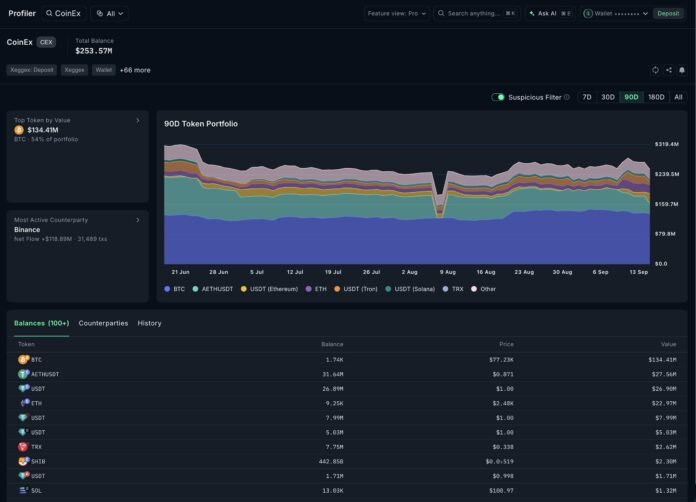
Data from Nansen showed about $253.6 million sitting across CoinEx-labeled wallets following the shutdown announcement. Bitcoin accounted for more than half of the total, at roughly $134.4 million, while another $27.6 million was deployed through Aave. USDT and ETH together accounted for more than $50 million.
The balances do not necessarily represent customer liabilities because labeled exchange wallets can include operational funds and other assets. Their size still shows how much capital remains within CoinEx’s on-chain footprint as users move funds elsewhere.
CoinEx plans to keep withdrawals available until Dec. 22, giving customers almost three months after spot trading stops to remove assets. The exchange has said customer assets remain fully backed and has urged users to withdraw early to avoid congestion or delays as the deadline approaches.
The more immediate redistribution starts Sept. 29. Once CoinEx switches off spot markets, its remaining traders, market makers and token projects will need alternative venues, pushing another pool of crypto liquidity into a market where five exchanges already control nearly 88% of the trading measured by CoinMarketCap.