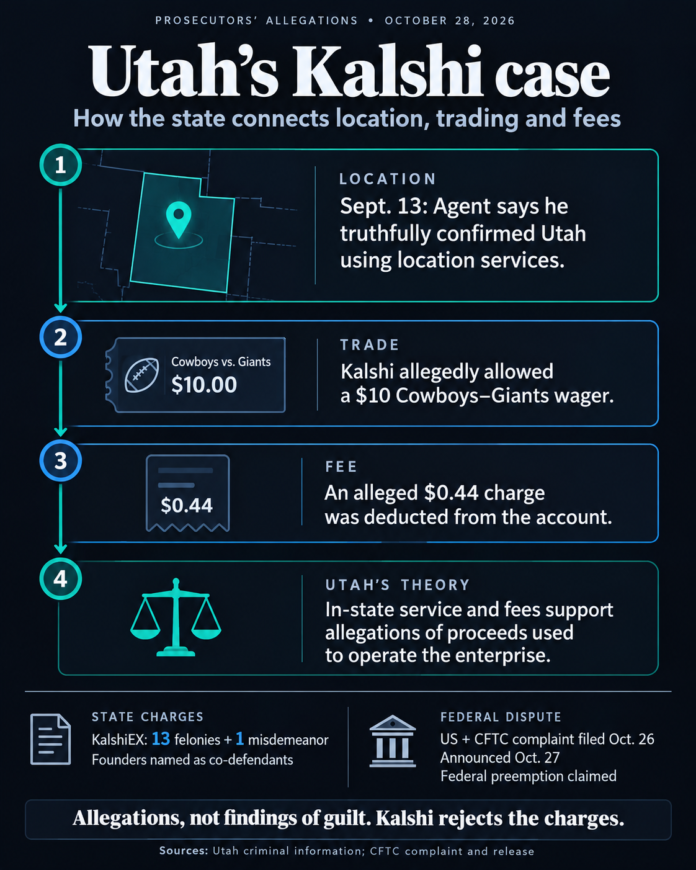
Utah filed 13 felony charges against Kalshi and named its two founders as co-defendants after an undercover agent placed $115 in sports bets.
The Oct. 28 criminal filing names KalshiEX, CEO Tarek Mansour and Chief Operating Officer Luana Lopes Lara, escalating a dispute over whether federally regulated prediction markets must comply with state gambling laws.
The prosecution follows an investigation in which a state agent placed 12 sports wagers totaling $114.87 on Kalshi between Sept. 13 and Sept. 26. The charges expose the company’s founders to potential criminal penalties as federal regulators challenge Utah’s authority to restrict the platform.
According to the filing, Special Agent Scott Eggerman created an undercover Kalshi account using a Utah residential address, phone number and locally issued debit card.
Before placing his first $10 wager on a Dallas Cowboys-New York Giants game, Kalshi allegedly required Eggerman to confirm his location through its location services.
Eggerman confirmed he was in Utah, but the platform permitted the transaction and collected a 44-cent fee.
He subsequently placed 11 additional wagers involving football, baseball, soccer and hockey events, generating further transaction fees for Kalshi.
Prosecutors cited those transactions in bringing 12 third-degree felony counts of online gambling promotion, one second-degree felony count of engaging in a pattern of unlawful activity and a misdemeanor gambling promotion charge.
The filing alleges that Kalshi collected revenue from unlawful gambling activity and reinvested the proceeds into its operations. It also cites public statements by Mansour and Lopes Lara describing their direct control over the company’s management and business activities.
Both executives were named as co-defendants and issued court summonses rather than arrest warrants.
Kalshi rejected the allegations, describing the prosecution as a “crazy overreach” and accusing Utah of “playing politics.”
Kalshi faces criminal prosecution as CFTC challenges Utah’s authority
The criminal case intensifies a jurisdictional fight that has already drawn intervention from the US Commodity Futures Trading Commission (CFTC).
On Oct. 26, the CFTC and the US government sued Utah, seeking to prevent the state from enforcing gambling restrictions against federally regulated prediction markets.
The agency argues that the Commodity Exchange Act gives it exclusive jurisdiction over derivatives traded on registered exchanges, including Kalshi’s event contracts.
Utah has maintained that federal registration does not exempt the platform from state gambling restrictions.
The state secured a significant legal victory in August when a federal judge rejected Kalshi’s argument that federal law prevented Utah from enforcing its gambling laws. The Tenth Circuit subsequently declined to suspend enforcement while the company appeals.
Utah also filed a separate civil lawsuit on Oct. 20, seeking to prohibit Kalshi from offering contracts involving sports, elections, politics and other events to residents. The state wants Kalshi to implement court-approved geolocation controls and surrender profits generated from allegedly unlawful transactions.
The dispute gained further national backing on Oct. 29 when a coalition of 37 state attorneys general filed a brief supporting Utah’s regulatory authority in the pending federal appeal.
The coalition’s intervention increases pressure on Kalshi as it fights to preserve nationwide access to its contracts under a single federal regulatory framework.
A ruling allowing Utah to enforce its restrictions could force Kalshi to block affected contracts for residents and expose revenue earned in the state to recovery claims, while the company’s founders confront a separate criminal proceeding.