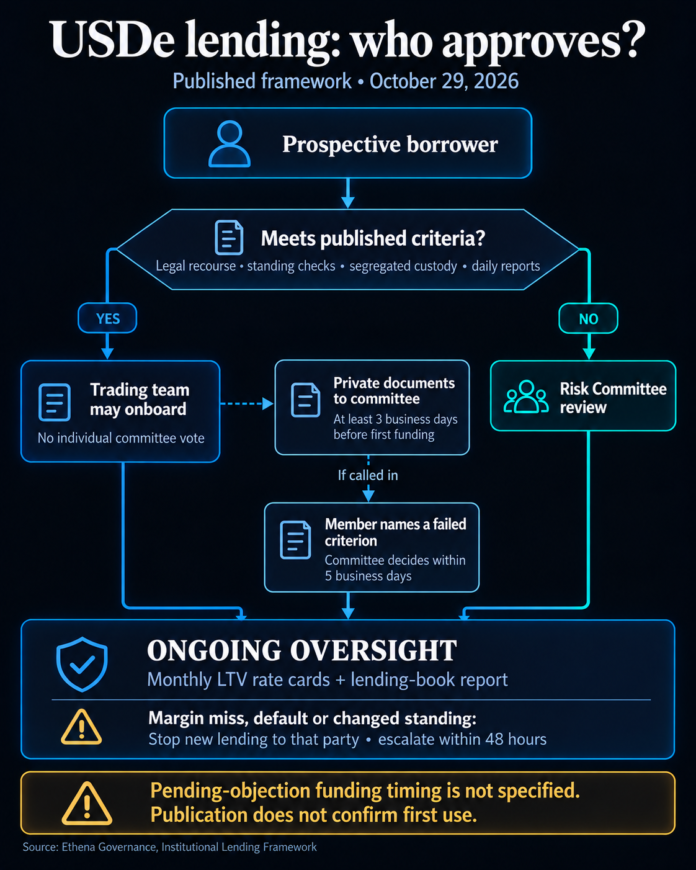
Ethena’s October 29 institutional-lending framework sets out a route for its trading team to onboard qualifying borrowers of assets backing USDe without an individual Risk Committee vote.
The posted rules describe a change in approval authority over lending that helps back Ethena’s synthetic dollar. For USDe holders, published eligibility rules and exposure disclosures offer a way to assess that credit risk. The committee retains oversight, with borrower documents sent to it privately.
The framework posted by Kairos Research describes the delegated route; it identifies no newly funded borrower using it.
Screening moves to the trading team under the published route
Eligibility combines bilateral lending with full recourse to the borrower or a parent guarantee, jurisdiction and standing checks, sanctions screening, segregated tri-party custody and verifiable daily collateral reports. The custody arrangement puts collateral with a third party.
Borrower documents go privately to the committee at least three business days before first funding. A member calling a borrower in must identify a failed criterion, with a decision within five business days. The committee therefore retains a criterion-based call-in power, while the text leaves funding during a pending objection unspecified. Cases outside the framework still require committee review.
The lending team sets loan-to-value rate cards, shared monthly with the committee alongside book reporting. Loan-to-value measures the amount lent relative to collateral value. A missed margin call, default or changed standing stops new lending to that counterparty and triggers escalation within 48 hours.
The permitted collateral includes BTC, ETH and other specified assets. USDe, sUSDe, ENA, USDtb and borrowers’ own assets are excluded; Ethereum-based XAUT is conditional on custody, liquidation venues and a weekend liquidation test.
The framework preserves five existing approvals. Its public text sets no numerical aggregate lending cap or per-borrower concentration ceiling.
Ethena’s institutional-lending documentation places aggregate exposure limits under governance and committee review, without publishing a numerical ceiling.
The earlier partner-by-partner approach is visible in the March 10 Maple and Anchorage proposal. It said additional offchain partners would need new proposals to the Risk Committee. LlamaRisk, Kairos Research and Blockworks Advisory subsequently posted support for the reviewed agreements.
Those reviews already kept contractual terms confidential. The October development concerns approval authority; confidentiality predates it.
The March discussion also shows why a partner’s brand is insufficient to identify the legal claim. Anchorage’s agreement was with A1, Ltd., a Cayman Islands group entity distinct from the OCC-chartered Anchorage Digital Bank. Maple’s pool-based agreement ran through Delaware’s Protocol Pool Operations Alpha LLC.
LlamaRisk’s April legal-review methodology names Ethena (BVI) Limited as the entity deploying reserve-backing assets. It examines collateral ratios, custody segregation, perfected security interests, liquidation rights, recall and redelivery timing, and practical enforceability.
The signing entity and contract matter because they govern the claim on borrowed assets and collateral.
Retaining the five existing approvals preserves arrangements with different structures; it does not establish that every legacy pool or warehouse meets the new bilateral criteria. LlamaRisk’s August 4 FalconX review described warehouse financing to FalconX International Lending Opportunities SPC for its segregated portfolio SP 1. The vehicle acquires institutional loan receivables and pledges its assets to Ethena, rather than operating as an ordinary bilateral borrower.
FalconX then announced a $1 billion secured SPV facility on August 19. That was an announced financing capacity, not a verified outstanding loan balance on November 1.
Dated allocations leave the live book unresolved
LlamaRisk’s October 12 assessment allocated 14.3% of backing to institutional lending, against total reported backing of roughly $5 billion and a similar USDe supply.
Blockworks Advisory’s Q3 governance update, published October 13, put institutional lending at 8% of liquid cash as of September 30. The two percentages use different dates and denominators. Comparing them as a rise from 8% to 14.3% would therefore be misleading.
CryptoSlate’s earlier lending analysis examined how allocations and recovery terms affect redemption liquidity. The October framework adds the question of which borrowers may enter through delegated screening.
Ethena’s lending dashboard describes collateral held with custodians, continuous LTV monitoring and no rehypothecation, meaning collateral is not pledged onward. In the November 1 text capture available for this report, borrower rows and the update time were unpopulated. It therefore provides no current borrower-level exposure or collateral ratios.
For holders, a usable assessment would put those elements together: the signing entity, its current outstanding amount, collateral and LTV, concentration against the relevant limit, and information to assess enforceability and recovery prospects.