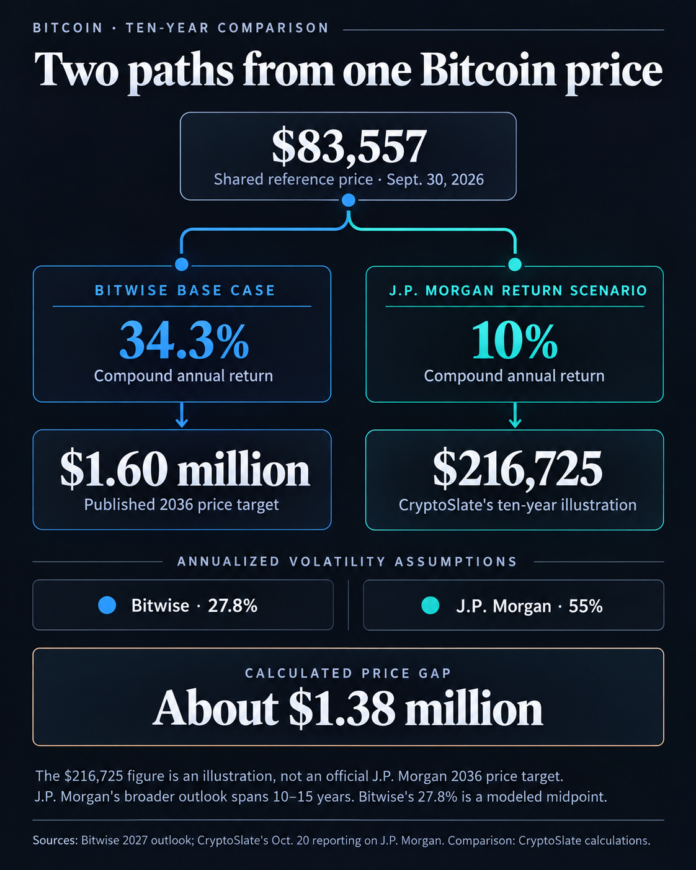
Crypto asset manager Bitwise projected a $1.6 million Bitcoin price for 2036 in its updated outlook released Oct. 28, making the growth of a combined gold-and-Bitcoin market central to its investment case.
Its 34.3% annual return forecast differs sharply from the 10% compound return assumption in JPMorgan’s newly introduced Bitcoin scenarios. Applying that lower return to Bitwise’s starting price produces a roughly $1.4 million gap.
An illustration compounds Bitwise’s $83,557 September reference price at 10% for exactly ten years, producing about $216,725. Bitcoin traded near $81,070 as of press time, with a market value of about $1.6 trillion.
JPMorgan released its assumptions on Oct. 19, introducing Bitcoin return scenarios without adding it as an allocation in its main portfolio framework.
Reports noted a 55% annualized volatility alongside JPMorgan’s 10% compound return assumption. Bitwise uses 27.8% as the midpoint between current and modeled 2036 volatility, and expects future institutional Bitcoin allocations of 1% to 5%.
JPMorgan questions whether currency debasement will cause a rush into crypto, citing Bitcoin’s volatility and unstable correlations as obstacles to widespread portfolio inclusion. It includes Bitcoin in a smaller comparison of how assets move together while keeping it outside its main portfolio models.
For Bitwise, institutional adoption and demand for stores of value support the valuation. JPMorgan’s argument shows why recognizing potential returns and making a strategic portfolio allocation remain separate decisions.
The $110 trillion assumption behind the target
Bitwise’s valuation framework estimates the future size of markets Bitcoin could serve, assigns it a share of each and divides the combined value by 21 million coins.
The dominant category is the store-of-value market, defined as gold and Bitcoin together. Bitwise assumes that market grows from its $31.1 trillion estimate to $109.8 trillion by 2036, with Bitcoin capturing 25%. It reaches its market-size estimate by extending historical growth into the future.
That produces $27.45 trillion of Bitcoin value from this category alone, representing about 82% of the roughly $33.6 trillion valuation implied by Bitwise’s precise $1,599,766 base target.
A seven-figure Bitcoin price depends on the combined market becoming much larger and Bitcoin winning a larger share. Market valuation growth can exceed the cash entering the assets because higher prices revalue existing holdings.
Bitwise’s bear case is $130,686, while its bull case reaches about $3.67 million. The previous outlook targeted $1.3 million by 2035, so the new report also moves the forecast horizon forward a year.
CryptoSlate tested Bitwise’s dependency by holding roughly $6.15 trillion of target-derived value from other uses constant and changing only the size of the store-of-value market and Bitcoin’s share.
| Case | Store-of-value market | Bitcoin share | Price per BTC |
|---|---|---|---|
| Bitwise published base case | $109.8 trillion | 25% | $1.60 million |
| CryptoSlate sensitivity | $50 trillion | 25% | About $888,000 |
| CryptoSlate sensitivity | $50 trillion | 10% | About $531,000 |
The sensitivities reconstruct the non-store-of-value contribution from Bitwise’s published target and retain its 21 million supply denominator.
Other markets could change alongside the store-of-value market, so the exercise isolates the effect of changing this category while the remaining assumptions stay fixed.
Why forecasts can change before their deadlines
Institutions have precedent for preserving a bullish thesis while changing its timetable. On Dec. 9, 2025, Standard Chartered moved its $500,000 Bitcoin forecast from 2028 to 2030 as Geoffrey Kendrick reassessed corporate-treasury demand and reliance on ETF buying.
On Nov. 6, 2025, Cathie Wood said stablecoin adoption could remove about $300,000 from an earlier $1.5 million Bitcoin bull case. That public comment concerned a different starting case from ARK’s April model, which had a $2.4 million bull outcome.
Bitwise’s thesis could face three measurable tests: institutional allocations, Bitcoin’s share of the gold-and-Bitcoin market, and the growth of that market. Progress on those assumptions will be key well before 2036.