Stellar activated Protocol 28 as the blockchain hit a new sustained throughput record, adding tools designed for larger smart-contract deployments.
The network ran Protocol 28 by Sept. 17 after a scheduled mainnet upgrade vote a day earlier. The release lets developers move groups of Soroban smart contracts to new code at once and introduces changes intended to make contract data easier to migrate as applications evolve.
The upgrade coincided with a fresh performance milestone. Blockchain analysis firm Chainspect said Stellar averaged more than 211 transactions per second across 100 consecutive blocks, its highest sustained throughput on record.
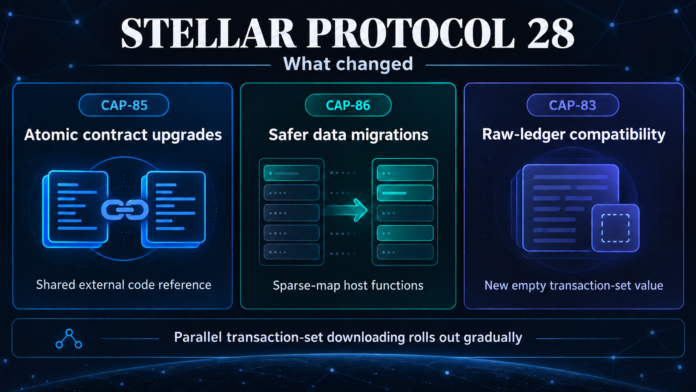
Protocol 28’s CAP-85 targets protocols that run multiple instances of the same smart contract. Developers can now have those contracts reference an externally managed executable, so changing the shared reference moves every participating contract to new code in a single atomic operation.
That can narrow the window during security fixes or software migrations when some contracts are running updated code while others remain on an older version. Adoption remains optional, meaning existing Soroban applications must choose to implement the new architecture.
CAP-86 tackles another problem that emerges as applications mature: changing the structure of data already stored by live contracts. New sparse-map functions can accommodate missing or additional fields, allowing developers to migrate information progressively rather than requiring records to conform immediately to a new schema.
Protocol 28 also introduces consensus changes through CAP-83. The design lets validators progress through parts of consensus without waiting for complete transaction sets to arrive and provides a mechanism to discard late or invalid sets.
Stellar is gradually enabling parallel transaction-set downloading, however, meaning the network’s 211-TPS milestone should not be treated as a performance gain produced by Protocol 28 itself. Instead, the upgrade builds infrastructure to support higher loads as the feature rolls out.
Stellar upgrade lands as economic activity expands
The technical changes arrive as Stellar handles growing financial activity across stablecoins, tokenized assets and decentralized finance.
Data from DeFiLlama shows that stablecoin supply on the network has risen over the past year to nearly $884 million, putting Stellar among the larger chains for dollar-linked assets. Its DeFi total value locked has followed a broader upward trend during the period, reaching a record of roughly $319 million in August before easing to about $294 million.
Tokenized real-world assets represent an even larger part of the network’s footprint. Token Terminal ranks Stellar as the third-largest blockchain by RWA market capitalization at about $3.3 billion, up $149.4 million over the past 30 days.
That growth raises the operational stakes for contract upgrades. Applications controlling larger pools of tokenized assets have more to manage when code needs patching or data structures change, giving CAP-85 and CAP-86 a commercial test beyond their technical design.
XLM also gained about 4% over the previous 24 hours, reaching $0.1863 before retreating toward $0.18 at press time. The move coincided with the protocol activation, though no evidence establishes the upgrade as the cause.
The next test will come from developers and validators. Soroban teams must opt into the new contract-management features, while Stellar gradually enables the consensus changes intended to support heavier traffic.
How quickly major issuers and applications adopt those capabilities will determine whether Protocol 28 becomes part of the infrastructure supporting the network’s expanding financial activity.