The Federal Reserve held its target range at 3.75% to 4% on Oct. 28 on a 10-2 vote. Governor Lisa Cook and Cleveland Fed President Beth Hammack dissented, favoring an immediate quarter-point hike.
Rate-market trackers put the odds of a December hike between about 83% and 88%, and the market had priced in a hold before the meeting.
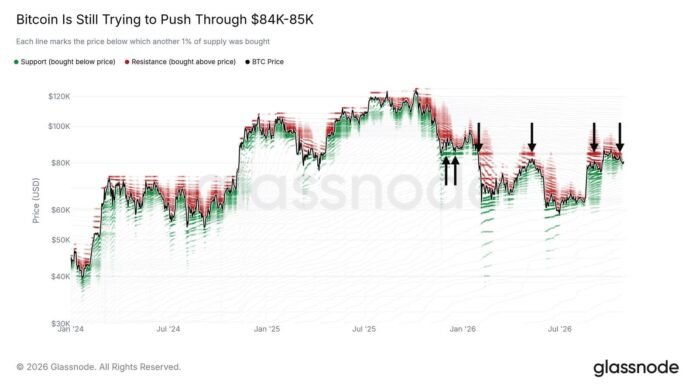
Bitcoin dipped to $80,500 and recovered above $81,000, within reach of the roughly $81,500 aggregate cost basis of US spot Bitcoin ETFs that Glassnode estimates.
The hold and Warsh’s message
The committee called growth strong and repeated its commitment to returning inflation to 2%.
At his press conference, Chair Kevin Warsh acknowledged that credit conditions had tightened, credit spreads had widened, and higher rates were affecting technology investment, including AI.
He declined to describe overall financial conditions as tight, suggesting the Fed is willing to tolerate more market strain before changing course. The 10-year Treasury yield sat near 5.04% on decision day and the two-year near 4.78%, while the University of Michigan’s final October sentiment index came in at 48.
Fabian Dori, chief investment officer at Sygnum Bank, said in a note:
“A hawkish hold is what the market expected, with no change for October and a 25bps hike for December priced in. Thursday’s PCE, a key decision variable for the Fed, being released just one day after the Fed decision, will be used as a timely decision validation.”
Dori also points to Magnificent Seven earnings this week, which should clarify whether AI capital spending is turning into revenue, and to liquidity and financial conditions as the drivers toward December.
He said a resolution of the Strait of Hormuz situation after the midterms could ease oil prices, inflation, and rate expectations.
The $81,500 test for Bitcoin
Glassnode’s Oct. 28 report described a market in which long-term holders control about 4 million BTC acquired between $85,000 and $118,000, representing potential supply as prices recover.
Those coins sit apart from sell orders, since holders returning to breakeven choose whether to sell. About 4.3% of supply last moved between $84,000 and $85,000, though Glassnode attributes much of that to one internal wallet transfer in November 2025.
Since the Oct. 24 decline, about $3.4 million of Binance bids were left at $80,000. The largest cluster sat at $78,000 to $79,000 with about $42 million, up from roughly $24 million in mid-October. The True Market Mean sits near $77,900 and the short-term holder cost basis near $75,800.
Matt Mena, senior crypto research strategist at 21shares, calls $80,000 the key support to defend, with a break exposing $77,000 to $78,000 and potentially $75,800.
He shared in a note:
“Reclaiming $81,000-$82,000, where the 50-day moving average and ETF cost basis converge, would open the door to $84,000-$85,000, followed by $87,000-$87,500.”
Softer inflation, easing yields, and a December pause could push Bitcoin toward $90,000 and beyond. The next key target is $94,000 to $95,000, where the mean MVRV price sits as a historically important on-chain valuation level. He treats the midterms as largely priced in.
Reluctant sellers, hesitant buyers
On Oct. 22, raw on-chain data showed about $3.7 billion of realized profit and $1.4 billion of realized loss, and Glassnode attributes the spike mainly to transfers between wallets of the same entity.
Entity-adjusted profit-taking ran near $260 million a day, about half its September peak. The largest daily net realized loss around Oct. 24 was about $27 million, against roughly $630 million at the August low, and wallets holding 100 to 1,000 BTC were October’s most persistent accumulators.
The 30-day realized volatility sits near 25%, below about 95% of readings since 2015. The picture shows sellers turning reluctant and buyers returning slowly.
Farside Investors’ data shows spot Bitcoin ETF net flows of negative $487.2 million between Oct. 22 and Oct. 27.
How much is priced
A simplified model treats December as a hold or one 25-basis-point hike. At 87%, about 21.75 basis points of the hike are already embedded in expected policy.
A drop to 50% would remove about 9.25 basis points, and a rise to 95% would add about 2. The larger market effect may come from revisions to the 2027 rate path, which the December projections will update.
Brendan Ma, head of investment strategy at the Arbitrum Foundation, reads the hold with two dissents as keeping December live, with most of it priced.
He points to tokenized stocks up around 12% over the past month while tokenized Treasuries shrank, even with the 10-year near 5%.
Ma said:
“Capital on-chain is moving to where it can be used, not just where it’s paid to wait.”
RWA.xyz data shows distributed value of tokenized stocks up about 17.8% over 30 days.
Where Bitcoin goes from here
If PCE, GDP, and the Nov. 6 payrolls soften inflation expectations, yields ease, and ETF inflows repeat, Bitcoin has a path through $81,500 and sustained closes above $85,000.
The next step is $87,000 to $87,500, where overhead supply thickens. The 30-day volatility near 25% implies a one-standard-deviation range of roughly $74,100 to $87,900 through Dec. 9 from $81,000.
If inflation surprises higher, Treasury yields climb, and ETF withdrawals resume, a close below the $78,000 to $79,000 bid area and the $77,900 True Market Mean would put $75,800 in view.
A fall would carry more weight if entity-adjusted realized losses began expanding while redemptions persisted.
Bitcoin’s selling has stayed subdued while its buying has stayed thin, and the next PCE, jobs, and CPI readings will show which side gives way as the Dec. 8-9 meeting approaches.