OranjeBTC’s DIGY11 product page on Sept. 15 marked the exchange-traded fund as “now on B3” and displayed a value of R$10.04 per unit. Its updated status signaled that Brazilian investors could access a fund tied to Bitcoin-treasury companies without buying Bitcoin itself.
DIGY11 is not a spot Bitcoin ETF and does not seek to match Bitcoin’s price. It follows a Brazilian real-hedged MarketVector index of preferred shares issued by companies whose balance sheets include substantial Bitcoin holdings.
B3, Brazil’s stock exchange, said that secondary-market trading would not begin as planned on Sept. 11, at the fund manager’s request. DIGY11’s product page later reported R$27.5 million in net assets and a R$10.00 net asset value per unit for Sept. 11, separate from the R$10.04 value displayed on Sept. 15.
What investors are buying
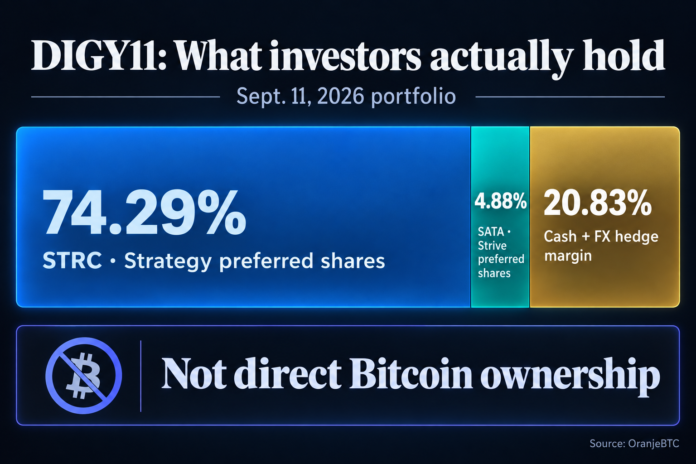
The fund’s disclosed Sept. 11 portfolio was concentrated in Strategy, the largest of the two US Bitcoin-treasury companies represented. STRC, Strategy’s preferred stock, accounted for 74.29% of assets. Strive’s SATA preferred shares made up 4.88%, while 20.83% was cash in reais and margin allocated to the currency hedge.
STRC and SATA are perpetual, variable-rate preferred securities. Their value depends on the issuers’ dividend policies, capital structures, and market conditions, including the effect of Bitcoin prices on the companies’ balance sheets.
Strategy and Strive do not pledge the Bitcoin they hold as segregated collateral for these preferred shares.
Strategy’s August filing disclosed a 12% annualized STRC rate and declared semi-monthly payments. Strive’s SATA pays on business days after monthly board declarations, according to the company’s disclosure.
Both rates can change, and neither is a guaranteed return for DIGY11 investors.
DIGY11 aims to make monthly distributions in reais when applicable, and its currency hedge is designed to reduce changes in the dollar-real exchange rate.
OranjeBTC presents a potential annual return of CDI, Brazil’s interbank benchmark rate, plus 3% to 5%. It labels that range an illustrative estimate, and says the calculation excludes changes in DIGY11’s unit value.
Fund costs further separate the preferred-share payouts from an investor’s return. DIGY11 charges a 0.90% annual management fee and at least 0.055% annually for administration and custody, before other possible expenses.
The result is a local preferred-income product whose distributions and unit value can change with the issuers, the securities, and the hedge. The product page also states that returns and distributions are not guaranteed and that the fund has no FGC protection.