Bitcoin whales are accumulating before Wednesday’s US inflation report, despite $744 million in recent spot ETF withdrawals.
According to an Oct. 13 CryptoQuant report, large holders have increased their combined Bitcoin holdings to 3.03 million BTC, with accumulation accelerating to its fastest monthly pace since February.
The buying contrasts with $744.3 million in net withdrawals from US spot Bitcoin ETFs across six trading sessions through Oct. 12.
The divergence comes as Bitcoin trades near $83,000 ahead of September’s Consumer Price Index report, which is expected to show inflation accelerating. The release will test whether growing confidence among large holders can withstand continued pressure from interest rates and weaker investment flows.
Bitcoin whales rebuild holdings as smaller investors retreat
CryptoQuant’s latest assessment suggests that Bitcoin’s largest investors have shifted from selling their holdings to accumulating again following several months of subdued activity.
The analytics firm said the 30-day growth rate of whale balances, excluding exchange and mining pool addresses, reached its highest level since Feb. 11.
Meanwhile, the annual change in whale holdings has recovered toward positive territory after remaining in contraction since September 2025. The improvement suggests that buying by large holders is beginning to reverse an extended period of distribution.
CryptoQuant sees the development as part of a broader recovery in Bitcoin’s market conditions.
Its Bull Score Index, which combines 10 on-chain and market indicators, climbed from 20 in late July to 90 on Sept. 26, its strongest reading since December 2024. Although the index has since retreated to 80, CryptoQuant considers that level consistent with an emerging bull market.
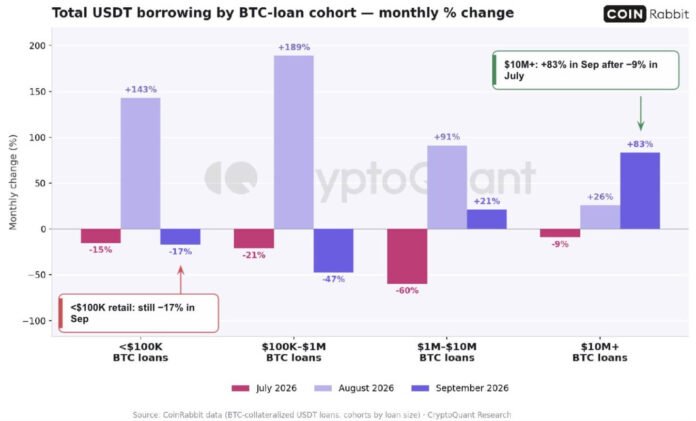
The renewed accumulation also coincides with a sharp increase in borrowing activity among large Bitcoin-backed borrowers.
Data from crypto lending platform CoinRabbit shows that borrowers with loans exceeding $10 million increased their USDT borrowing by 83.3% in September, reversing a 9.2% contraction in July. Their average loan size also increased by 33.5%.
By comparison, borrowers with loans below $100,000 reduced their total borrowing by 17.2%, while those in the $100,000 to $1 million category recorded an even steeper decline of 47.3%.
The figures suggest that larger participants are becoming more comfortable accessing liquidity against their Bitcoin holdings, even as smaller borrowers reduce their exposure.
Borrowing against Bitcoin allows holders to obtain dollar liquidity without immediately selling their coins, although the data does not establish whether the borrowed funds were subsequently invested in Bitcoin or deployed elsewhere.
CryptoQuant founder Ki Young Ju described the divergence between large and smaller participants as consistent with the early stages of a market recovery, when major holders begin increasing their exposure before broader demand returns.
However, that growing confidence has yet to translate into consistent buying through US-listed Bitcoin investment products.
Bitcoin ETF withdrawals challenge whales’ growing conviction
Data from Farside Investors shows that US spot Bitcoin ETFs recorded $744.3 million in net outflows between Oct. 5 and Oct. 12, reversing part of the institutional demand that supported Bitcoin’s September recovery.
The heaviest selling occurred on Oct. 7, when the funds lost $484.9 million, followed by another $244.1 million in withdrawals the next day.
The outflows accompanied Bitcoin’s decline below $81,000, temporarily erasing the gains that followed its September breakout.
However, the selling showed signs of moderating on Oct. 13, when the ETFs attracted $175.7 million in fresh capital. Fidelity’s FBTC led the recovery with $103.1 million, followed by $65.9 million into BlackRock’s IBIT.
That rebound reduced the net withdrawals across the seven trading sessions to $568.6 million, although it remains unclear whether the inflows signal a sustained return of institutional demand.
The recent weakness also contrasts with CryptoQuant’s longer-term assessment, which shows US spot ETFs have recovered to approximately $1.5 billion in net inflows for 2026 after recording a year-to-date deficit of $5.1 billion in early July.
The differing timeframes suggest that institutional investors have been rebuilding their positions over several months, even as some have reduced exposure during Bitcoin’s latest correction.
Other market indicators point to similarly uneven demand.
In its Oct. 12 report, Glassnode found that Bitcoin perpetual futures traders had become aggressive sellers, with cumulative volume delta falling to negative $681.8 million.
Yet the firm’s measure of monthly realized capitalization growth increased to 1.2% from 1.1%, indicating that capital continued entering the network despite the selling across ETFs and derivatives markets.
That combination leaves Bitcoin with supportive longer-term accumulation trends but less convincing demand from investors responding to immediate market conditions.
US inflation report puts Bitcoin’s recovery to the test
The conflicting positioning comes ahead of Wednesday’s CPI report, which could reshape expectations for Federal Reserve interest rates before its Oct. 27-28 policy meeting.
Economists surveyed by Reuters expect headline inflation to accelerate to 3.6% in September from 3.4% in August, driven largely by higher energy costs. Core inflation, which excludes food and energy, is projected to edge up to 2.5% from 2.4%.
The figures arrive as elevated Treasury yields and concerns about persistent inflation continue to weigh on risk assets.
A stronger-than-expected inflation reading could reinforce expectations that the Fed will keep monetary policy restrictive or consider additional tightening, potentially extending the selling pressure already evident in Bitcoin’s ETF and derivatives markets.
Conversely, softer inflation could ease pressure on yields and encourage investors to rebuild exposure, allowing the cryptocurrency to benefit more directly from renewed whale accumulation.
Glassnode has identified substantial buying interest around $81,000 to $81,250, providing a potential support area if Bitcoin comes under further pressure.
On the upside, sellers have concentrated orders around $85,000 to $85,500, with additional resistance near $86,500 to $86,750. A recovery through those levels could bring the $88,000 region back into focus, where investors who accumulated Bitcoin over the past year have previously taken profits.
For now, the accumulation by large holders has not prevented Bitcoin from struggling to sustain a recovery above $85,000.
Wednesday’s inflation figures will provide the next major catalyst, while subsequent ETF flows will show whether Tuesday’s return to buying marks the beginning of renewed demand or another temporary reprieve from selling.
