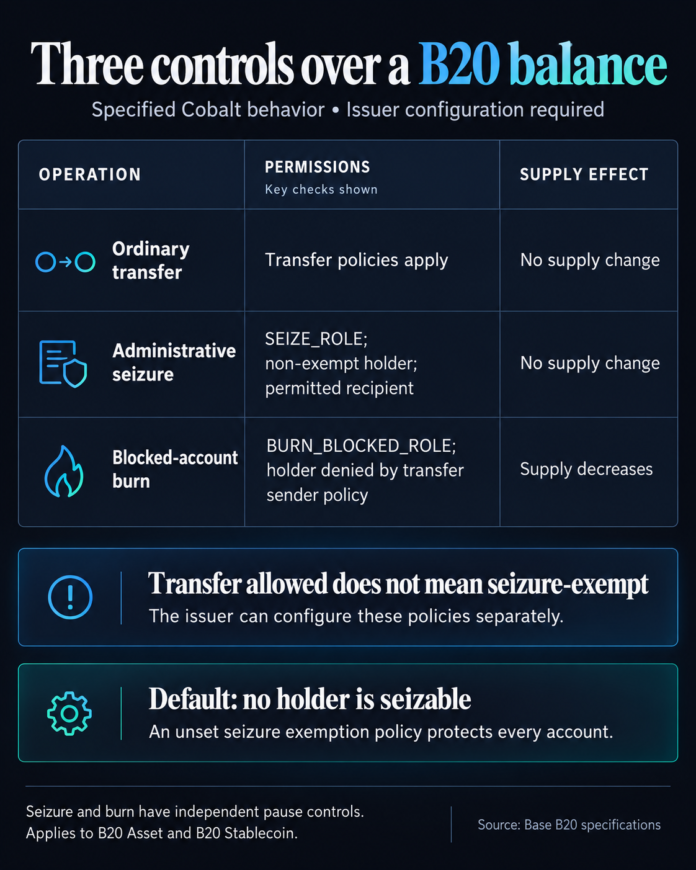
Base’s Cobalt upgrade, scheduled for mainnet Sept. 30 at 18:00 UTC, will let issuers of B20 tokens configure balance seizures separately from ordinary transfer restrictions. For a token that enables the feature, a holder could remain free to transfer while still being eligible for administrative reassignment.
B20 is Base’s native ERC-20-compatible token standard, offered in Asset and Stablecoin variants. It already gives administrators control over roles and policies governing balance movements, and now it will also govern the administrative powers over those balances.
Role assignments identify who can exercise a particular power, while policy settings determine which accounts an operation can affect. Changing a token’s rules and executing a balance operation involve distinct permission checks.
Separate seizure permissions
The new administrative operation, called seizeWithMemo, moves a specified amount from a holder to another address. It preserves total supply and skips ordinary transfer policies and holder allowances.
An issuer must configure which accounts lose their exemption before the function can take their tokens. The setting, SEIZE_EXEMPT_POLICY, exempts everyone when left unset. Configuring eligibility alone is insufficient: execution requires SEIZE_ROLE, an unpaused seizure function, a permitted recipient, and sufficient balance.
A separate recipient policy determines where the seized tokens can go, and leaving that policy unset allows any otherwise valid destination. The holder’s ability to make an ordinary transfer does not answer either seizure-policy question.
B20’s existing transfer policies check the sender and receiver, plus the executor for certain transfers on another account’s behalf. Administrators can update those policies. Approving a spender does not remove the checks on the eventual transfer, but those ordinary transfer permissions are distinct from Cobalt’s seizure rules.
B20 also already has burnBlocked, which lets an authorized caller destroy tokens held by an account denied by the transfer sender policy. Cobalt marks that function deprecated but keeps it callable with its existing behavior.
That leaves issuers with different ways to remove a holder’s balance. Reassignment keeps the tokens in circulation at another address, while destroying the seized supply requires a subsequent burn. Seizure and burning have separate administrative roles and pause controls.
Base’s status page lists the mainnet upgrade as scheduled, with maintenance from 18:00 to 20:00 UTC. The upgrade overview lists Sepolia as live since Sept. 23 and mainnet as shipping on Sept. 30.
The v1.4.2 release adds Cobalt mainnet support and instructs node operators to upgrade by Sept. 30 at 18:00 UTC.
