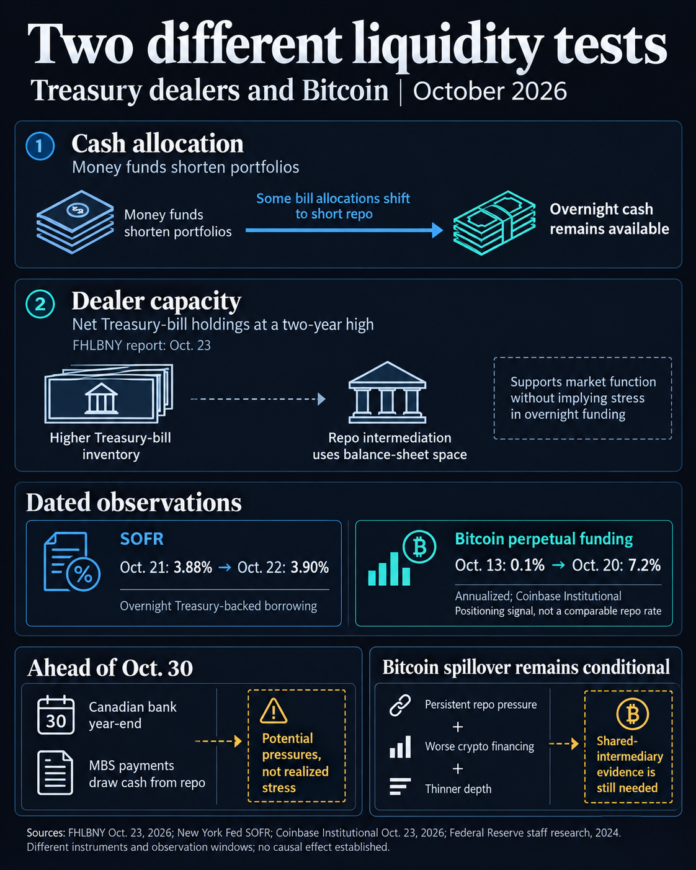
Treasury dealers’ net holdings of bills, short-term U.S. government debt, have reached a two-year high, according to the Federal Home Loan Bank of New York’s October 23 update. Financing those inventories puts dealer capacity in focus ahead of October 30, even while overnight dollar funding looks calm.
FHLBNY attributes wider bill spreads partly to heavy issuance and money market funds shortening their portfolios amid uncertainty about Federal Reserve policy. Some cash has shifted from bill buying into overnight and short-term repurchase agreements, or repo. That allocation can support overnight lending even as dealers hold substantial bill inventories.
The distinction is between cash being available and intermediaries having room to pass it on. A 2024 Federal Reserve staff study explains that moving repo cash from money funds to leveraged borrowers expands dealer balance sheets. Its authors hypothesize that tighter constraints increase the compensation dealers demand.
Overnight conditions have remained calm. The latest New York Fed SOFR observations available on October 25 put the Treasury-backed borrowing benchmark at 3.9% for October 22, up from 3.88% on October 21. FHLBNY said SOFR stayed at or below the Fed’s 3.9% interest rate on reserve balances during the report’s week.
FHLBNY flags Canadian bank year-end on October 30 and cash leaving repo to pay mortgage-backed-security holders as forthcoming pressures. It says SOFR may test 3.9% more steadily. Calmer Thursday bill auctions than the previous week provide a counterweight to those risks.
Bitcoin’s financing gives a separate reading
Bitcoin’s positioning data show rebuilding leverage. Coinbase Institutional’s October 23 research reported perpetual funding rising from 0.1% annualized on October 13 to 7.2% one week later. Its Prime Trading commentary separately interpreted rebuilding Bitcoin and Ether funding as momentum longs adding exposure. These derivatives payments measure the cost of maintaining leveraged positions, rather than a comparable repo borrowing rate.
For borrowing context, Coinbase’s financing table dated October 22 listed indicative centralized-finance overnight rates of 4.25%–12.5% and a Bitcoin borrowing range of 1.25%–4.75%. Without matched borrower and collateral terms or an earlier comparable quote, those ranges cannot establish a new tightening in credit.
Futures basis, the premium over spot prices, needs similar care. The 2023 BIS paper Crypto carry finds that interest-rate differentials explain little of its variation, emphasizing leveraged investor demand and the relative scarcity of arbitrage capital. Basis therefore needs to be read alongside borrowing conditions and positioning.
A Treasury-to-Bitcoin transmission case would strengthen if repo pressure persisted while comparable crypto borrowing or rollover terms worsened and market depth thinned. Stable crypto financing would weaken that explanation. Even simultaneous deterioration would leave causation to establish: evidence that constrained intermediaries actually reduced financing available to Bitcoin markets remains the missing link.