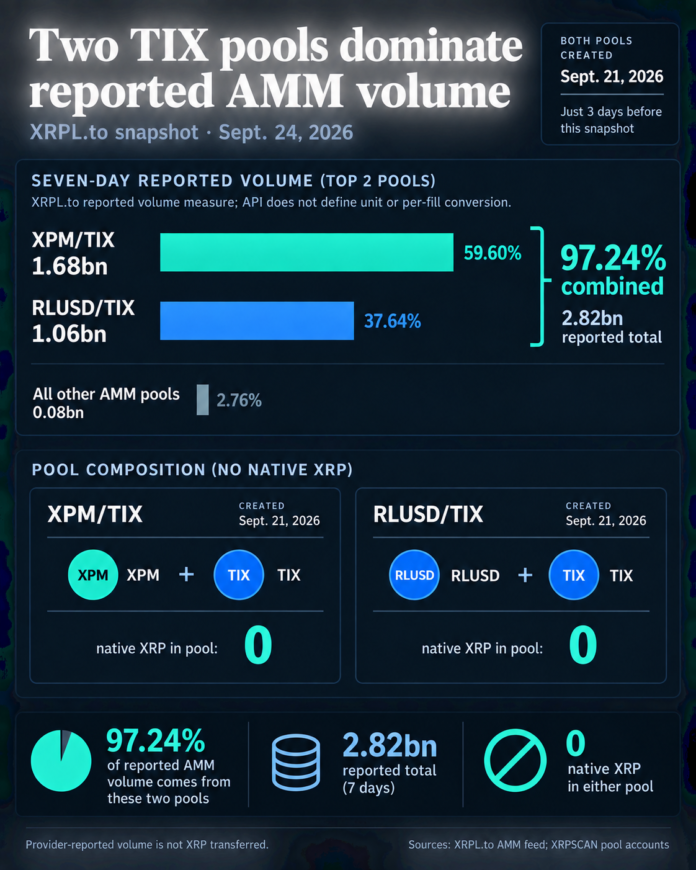
Two pools that exchange TIX for other issued tokens accounted for 97.24% of the seven-day automated market maker (AMM) volume in XRP Ledger (XRPL), according to XRPL.to’s Sept. 24 feed.
Neither pool contains XRP, so the outsized reading says far more about the provider’s volume measure.
XRPL.to listed a 2.82069 billion seven-day volume total, including 1.68 billion for XPM/TIX and over 1 billion for RLUSD/TIX.
Those figures describe the provider’s tally. The two pools were created Sept. 21 and list the same TIX issuer and pool creator, and XRPL.to counted 69 XPM/TIX trades and 116 RLUSD/TIX trades in its rolling seven-day window.
Neither had recorded a trade in the latest 24 hours at the Sept. 24 check. The count shows that fills occurred, but it does not establish how many independent traders took part or what those fills were worth.
A routed payment can pass through more than one pool, so pool-level counts should not be read as separate end-to-end customer payments.
What the XRPL ledger shows
A check of the XPM/TIX pool account found about 1,545 XPM and 9.69 million TIX in its reserves. The RLUSD/TIX account held only trace amounts of both assets and zero XRP.
The nearly empty account is a current liquidity warning, while the earlier trading window needs its dated balances to show what a trader could have exchanged then.
A validated payment from Sept. 22 provides one view of actual settlement. It routed through TIX and both AMM accounts, used about 5.89 XPM, and delivered 0.030177 RLUSD. Its ledger metadata shows the token balance changes at each pool.
However, it doesn’t explain why an end-to-end payment and the two pool legs involved are counted differently.
The ledger’s AMM rules allow pools to exchange two issued assets without an XRP trading side. Transactions still incur XRP network fees, and a longer payment route can use XRP elsewhere. Neither mechanism turns activity inside these two pools into evidence that someone bought new XRP.
To establish that demand, the trades would need to be traced through any XRP legs and separated from inventory participants already held.
XRPL dashboard leaves token-token pools out of its headline XRP-paired value locked because those reserves are harder to price in dollars. DefiLlama’s XRPL DEX page showed $55.1 million in seven-day volume, while its adapter uses XRP-pair and AMM XRP-volume metrics.
Those figures cannot be set directly against XRPL.to’s token-token tally as though they counted the same trades at the same prices.
The open question is the value attached to each TIX fill in XRPL.to’s total. Until that conversion can be reproduced against the on-chain trades, the 97.24% concentration is best understood as a feature of one reported measure.
For XRP holders, recurring volume in pools that actually hold XRP, backed by verifiable reserves and valued fills, would be a more direct sign of trading demand. Such evidence would also distinguish a one-window spike from trading that persists after the newest pools have aged and their initial liquidity has changed.
