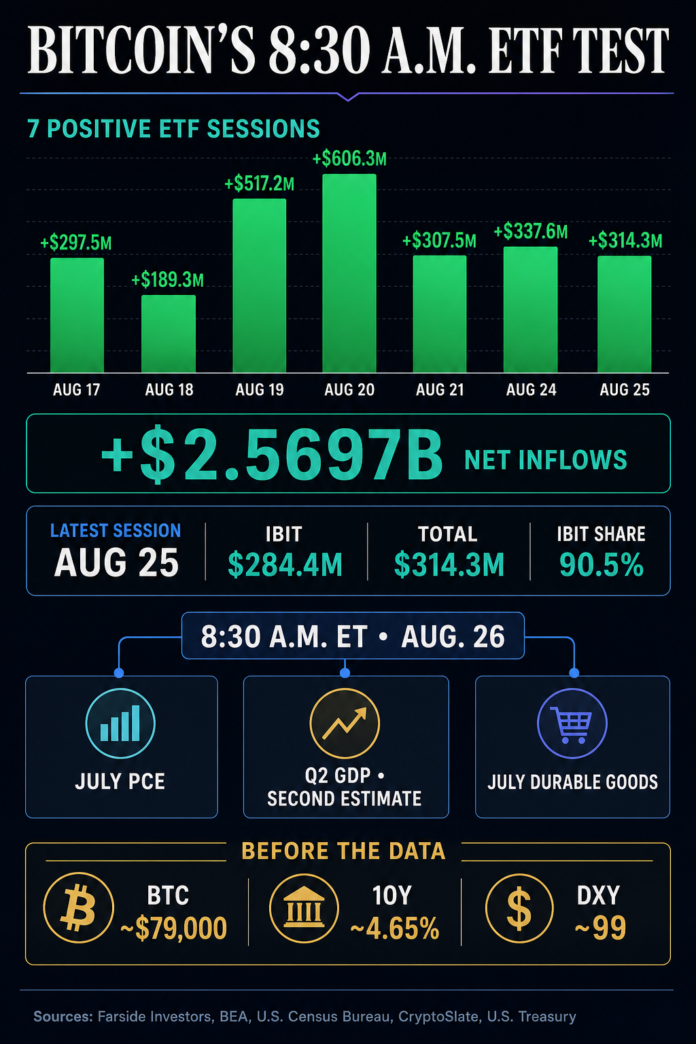
At 8:30 a.m. ET on Aug. 26, Bitcoin’s seven-session spot ETF inflow streak faces a concentrated macro test as three U.S. reports land at the same minute.
The U.S. Bureau of Economic Analysis is scheduled to publish July Personal Income and Outlays, including the PCE inflation indexes, alongside its second estimate of second-quarter GDP. The U.S. Census Bureau will release July advance durable-goods orders at the same time.
Ahead of the data, CryptoSlate’s Bitcoin market data put BTC near $78,508, down about 2% over 24 hours but still up roughly 22.8% over seven days. The asset therefore enters the release window with substantial recent gains, but without evidence yet of how it will respond to a fresh move in yields or the dollar.
The ETF inflow streak is measurable. Farside Investors’ daily table shows seven consecutive positive U.S. spot Bitcoin ETF sessions from Aug. 17 through Aug. 25. Adding those daily totals produces $2.5697 billion in net inflows. However, fund-flow data do not identify end investors, so the aggregate cannot establish broad institutional participation on its own.
The latest session was also highly concentrated. BlackRock’s IBIT accounted for $284.4 million of the $314.3 million total on Aug. 25, or about 90.5%. That distribution makes the streak a strong aggregate net-inflow signal, but not a uniform one across funds.
The inflation hurdle is specific. The Cleveland Fed’s Aug. 25 nowcast estimated July headline PCE inflation at 0.15% month over month and 3.65% year over year. It put core PCE at 0.25% monthly and 3.29% annually. Those figures are model estimates, not official results, but they provide a reference point for the release.
The cross-asset starting line adds another constraint. The official Treasury curve put the 10-year yield at 4.64% on Aug. 25, while overnight quotes held near 4.65%. A delayed U.S. Dollar Index quote put DXY near 99.00 and slightly above its prior close.
A possible absorption test is straightforward. If hotter inflation or stronger growth coincides with rising yields and a firmer dollar, Bitcoin holding near its pre-release level would be consistent with ETF demand offsetting some of the pressure. A sharp decline would instead suggest that seven positive sessions provided support, not immunity.
Neither outcome can be claimed before the reports land. The starting markers are Bitcoin near $79,000, the 10-year yield near 4.65%, and DXY near 99 immediately before 8:30, followed by the first verified move across all three markets.